
Many clients who sit down with me to design a ring ask the same question: natural or lab-grown? There is no single right answer; the best choice depends on what matters most to you. This guide lays out the facts on beauty, how lab diamonds are made, energy and pollution, and community impact, so you can decide with confidence.
Beauty: you cannot tell them apart by eye
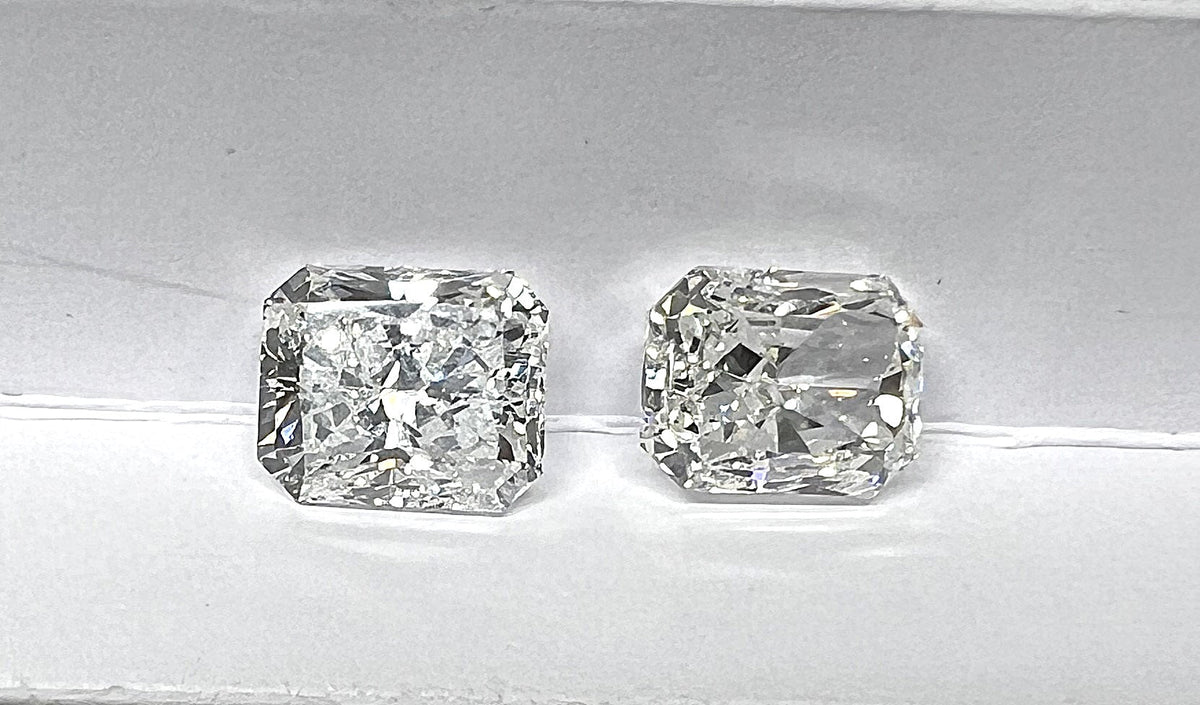
A lab-grown diamond is not a look-alike like cubic zirconia or moissanite. It is pure carbon in the same crystal structure as a natural diamond, with the same hardness, sparkle and fire. Set side by side, no one can tell them apart with the naked eye, including experienced jewelers.
Even the standard diamond tester most jewelers use can't tell them apart; both simply read as "diamond." Identifying a lab-grown stone takes specialized lab grown diamond tester. The telltale sign is nitrogen: natural diamonds almost always contain tiny traces of it, picked up deep in the earth over billions of years, while lab-grown diamonds typically have none.
How lab diamonds are made: HPHT vs. CVD
Natural diamonds formed 100 to 200 km below the earth's surface, under crushing pressure and heat, over billions of years. Labs recreate those conditions in weeks, using one of two methods. Both start with a tiny diamond "seed."
• HPHT (High Pressure, High Temperature): The seed sits in a press with a carbon source and a metal that helps the carbon dissolve. The press squeezes it at around 50,000 times normal air pressure and roughly 1,400 to 1,600 °C. The carbon melts and crystallizes onto the seed, layer by layer. This is the closest copy of how nature does it.
• CVD (Chemical Vapor Deposition): The seed sits in a vacuum chamber filled with carbon-rich gas, usually methane and hydrogen. Microwaves heat the gas into a glowing plasma, which breaks it apart. Carbon atoms then rain down and build up on the seed, like snow settling in thin layers. CVD stones often get an extra heat treatment afterwards to improve their color.
Energy and pollution: the honest picture
Lab-grown diamonds are often sold as the "green" choice, but the real answer depends almost entirely on where the electricity comes from. Growing a diamond takes a lot of power: presses and plasma reactors run nonstop for days or weeks. Most lab diamonds today are grown in China and India, where the power grid still runs largely on coal.
Mining has its own footprint. It moves enormous amounts of earth, burns diesel in heavy trucks and machinery, uses water, and disturbs land and habitats. Every comparison has to weigh these different kinds of impact.
You'll see very different numbers quoted, and studies paid for by each side tend to favor their own product. What we do know:
• A lab diamond grown on coal power can carry a larger carbon footprint than a mined one. Analyst Paul Zimnisky has pointed out that many growers in China and India rely on coal-heavy grids.
• A lab diamond grown on clean power can have a very small footprint. But only a handful of growers worldwide run on truly clean energy, and they struggle to stay in business against the massive producers in India and China, which mostly rely on coal-heavy grids.
• Mining disturbs land and water directly in ways a factory does not, though responsible mines are required to restore the land when they close (more on that below).
• Transparency is limited on both sides. Most lab growers do not publish their emissions, and mining figures per carat vary by mine.
What natural diamonds give back to communities
This is where natural diamonds have a story lab-grown stones can't tell. A responsibly mined diamond can support entire communities and, in some cases, an entire country.
Botswana is the clearest example. Its main diamond producer, Debswana, is owned 50/50 by the government and De Beers, and a large share of the profit funds public hospitals, roads and schools. Debswana also:
• Runs schools and hospitals in the mining towns of Jwaneng and Orapa, which educate employees' children and the wider public.
• Pays for higher education: more than 1,160 Batswana have been trained at top universities around the world on Debswana scholarships since the 1970s, and the company helped found Botswana Accountancy College.
• Builds and equips local schools, such as new classrooms for Seaseole Primary School near the Letlhakane mine.
• Brings clean water to remote villages: the Debswana Diamond Trust paid $1.2 million to drill and maintain boreholes (deep water wells) for Tsodilo, a remote village in northwest Botswana.
Responsible mines must also plan for closure from day one. When Rio Tinto's Argyle mine in Australia closed, the company began dismantling the site, reshaping the land and replanting native vegetation, with the land returning to its Traditional Owners.
For balance: these benefits depend on the mine and the country. Not every diamond comes from Botswana or Canada, and smaller, informal mines in some regions have a far weaker record. Lab-grown diamonds create jobs too, mostly in cutting and growing centers in India and China. The key is to buy natural diamonds from a jeweler who can tell you where they came from, or at least guarantee they come from legitimate, responsible sources.
Price, value and rarity
Lab-grown diamonds cost far less up front, but they hold no value over time.
• Price: Lab-grown stones now cost roughly 85–90% less than comparable natural ones. A one-carat lab round that cost about $3,400 in 2020 was around $400 in early 2026.
• Resale: Lab-grown diamonds have no real resale value; many jewelers won't buy them back at all. Natural diamonds resell below retail, but they keep a meaningful share of their value.
• Rarity: Lab diamonds can be produced in unlimited quantity. Every natural diamond is billions of years old and one of a kind, and the world's mines are slowly running out.
In short: lab-grown gives you a bigger stone for your budget today. Natural gives you rarity, a story, and a stone that keeps more of its worth.
Making your choice
Both options are beautiful, real diamonds, and neither is the wrong choice. Ask yourself:
1. Is the biggest stone for my budget the priority? Lab-grown wins here.
2. Do I want something rare that keeps value and can be passed down? Natural is the stronger choice.
3. Is the environment my main concern? Neither choice is impact-free. Mining disturbs land and water, while most lab diamonds are grown with coal-heavy electricity. A responsibly mined diamond, from a mine that restores the land afterwards, can be just as sound a choice as lab-grown.
4. Do I care who benefits from my purchase? A natural diamond from a responsible source supports schools, hospitals and jobs in the communities where it was mined.